
Family & Cosmetic Dental PLLC
- Home
- Our Practice
- Services
- Patient Information
- Blog
- Contact Us
A missing tooth affects more than your smile. It can change how you chew, how you speak, and how pressure moves through your jaw.
Modern dental implants were developed to replace missing teeth with something more stable than a removable option. If you are wondering who does dental implants, the answer depends on the complexity of your case and who will plan, place, and restore the tooth.
The short answer is that implants may be placed by a general dentist with advanced implant training, an oral surgeon, a periodontist, or sometimes a prosthodontist. In many cases, more than one dental professional is involved.
Family & Cosmetic Dental PLLC offers dental implantsin Glendale, AZ and provides the kind of implant care you may be looking for.
Dental implant treatment usually has two parts. One is placing the implant in the jawbone, and the other is restoring it with a crown, bridge, or denture.
Because of that, one clinician may place the implant while another completes the final tooth. This is common and often beneficial.
Some general dentists place and restore implants after advanced continuing education and hands-on training. In straightforward cases, this can make treatment more convenient because one office may handle imaging, planning, placement, and the final crown.
Training and experience can vary widely. That is why it is reasonable to ask about provider qualifications, how often the office performs implant procedures, what types of cases are treated there, and when patients are referred to a specialist.
Oral surgeons are dental specialists trained in surgery of the mouth, jaw, and face. They often place implants in cases that involve extractions, significant bone loss, sedation needs, or more complex anatomy.
They may be the right fit when surgery is expected to be more involved. This can include cases with bone grafting, impacted teeth, or limited space near important structures such as nerves or the sinus.
Periodontics focuses on the gums and the bone that support the teeth. Because implant success depends on healthy tissue support, periodontists often place implants, especially when gum disease, recession, or bone loss is present.
A periodontist may be especially helpful when gum shape and tissue stability matter for both health and appearance. This is often important for front teeth, where even small differences in gum contour can be noticeable. For more background, see What is a periodontist.
Prosthodontics focuses on rebuilding teeth and bite function with crowns, bridges, dentures, and implant-supported restorations. Some prosthodontists also place implants, but many are most involved in planning treatment and designing the final replacement teeth.
This can be especially important when several teeth are missing or when appearance and bite balance are major concerns. In those cases, the final restoration should guide the implant plan from the beginning.
The better question is often not just who does dental implants, but who plans them, restores them, and monitors them over time. Good implant care depends on more than the surgical step alone.
Bone quality, gum thickness, bite forces, nerve location, sinus position, and the shape of the final tooth all matter before treatment begins. A well-planned implant should fit the biology and function of the mouth, not just fill an empty space.
In many cases, treatment involves a team. A general dentist may diagnose the problem, a surgeon or periodontist may place the implant, and a restorative dentistry clinician may complete the crown.
That kind of collaboration is often a strength. It means each part of care can be handled by the clinician whose training best matches that stage.
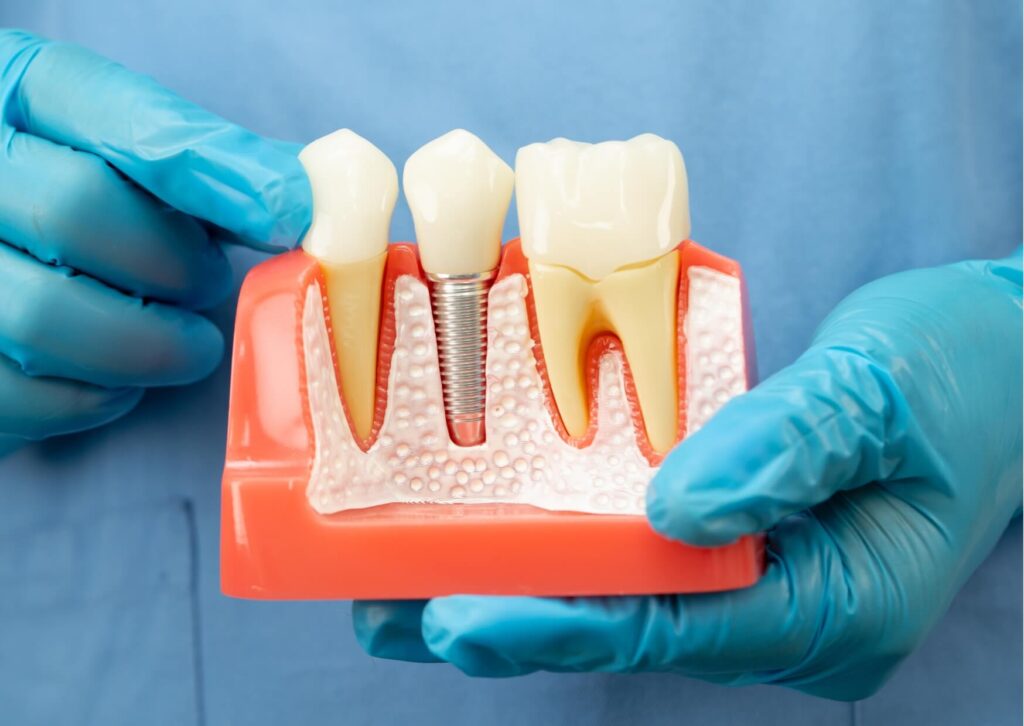
A dental implant is a small post, usually made of titanium or a titanium alloy, that is placed into the jawbone. Over time, the surrounding bone can bond to it through osseointegration, creating a stable foundation for chewing.
That bond is central to how implants work. Bone cells attach to the implant surface and remodel around it, helping create a secure connection between the implant and living bone.
Most implant treatment includes an exam, imaging, surgical placement, healing, and then restoration with the final tooth or prosthesis. Some cases are simple, while others require grafting, staged healing, or treatment for infection, grinding, or bite problems first.
Experience matters, but so does judgment. A trustworthy implant provider should explain not only how the procedure works, but why a specific plan makes sense for your mouth.
Look for clear discussion of imaging, bone and gum health, healing time, alternatives, and long-term maintenance. If the explanation feels rushed, vague, or overly sales-focused, that is worth noticing.
You do not need technical knowledge to ask good questions. In fact, simple questions often reveal how carefully a case is being planned.
Consider asking:
A good provider should answer clearly and directly. Implant treatment is often elective, so informed decision-making is an important part of care.

Not every missing tooth requires specialist care. But some situations clearly benefit from it.
Complex anatomy, advanced gum disease, major bone loss, trauma, and full-arch reconstruction often call for focused surgical or restorative expertise. A specialist may also be the better choice when replacing a front tooth, where gum symmetry and tooth position can strongly affect the final appearance.
Other reasons for referral include heavy clenching, a history of failed implants, significant medical complexity, or uncertainty about whether an implant is the best option at all. Sometimes the best decision is to delay treatment until the mouth is healthier and the plan is clearer.
Before implant treatment, symptoms such as infection, fracture, or active gum disease may need attention first. After treatment, certain changes can point to a healing problem or mechanical complication.
Seek prompt dental evaluation if you have severe swelling, fever, pus, or worsening pain, especially after a recent procedure. Also call a dentist soon if an implant feels loose, your bite suddenly changes, numbness continues, or bleeding and gum inflammation do not improve. These warning signs do not always mean implant failure, but they should not be ignored.
Timely care can help protect the implant site and the surrounding teeth and bone.
It is normal to compare providers based on cost or convenience. But implant treatment should also be judged by planning quality, case selection, and long-term follow-up.
A lower fee may be reasonable in a simple case. Still, if a treatment plan skips discussion of gum stability, bite design, or maintenance, the lower price may not reflect the full picture.
The best implant care usually feels measured rather than rushed. The office should make space for questions, explain uncertainty honestly, and show how the final tooth is expected to function over time.
If you are deciding who does dental implants in your area, a consultation focused on diagnosis and planning is often the most useful next step. The right clinician should leave you with a clearer understanding of both what treatment can do and where its limits are.
To schedule a dental implant consultation at Family & Cosmetic Dental PLLC in Glendale, AZ (serving nearby Phoenix and Chandler), call (602) 866-9825.
Yes. Some general dentists place and restore implants after advanced training. Whether that is the right choice depends on the dentist's experience and on how simple or complex the case is.
Both may be highly qualified. Oral surgeons often handle more surgically complex cases, while periodontists often focus on gum and bone support. The best fit depends on the anatomy, tissue health, and treatment goals.
Sometimes, but not always. In many cases, one clinician places the implant and another designs or attaches the final crown.
Not always. A single missing tooth with healthy bone and gums may be treated by a trained general dentist, but specialist input may help if the site is in the front of the mouth, bone is limited, or the case has cosmetic or surgical challenges.
Ask who will place the implant, who will restore it, what imaging is needed, what risks apply to your case, whether grafting may be needed, and how the implant will be monitored long term.